Analytical tests
edited by Lidia Barcellona and Elisabetta Giorgi
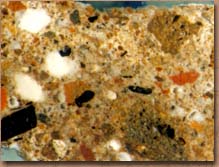
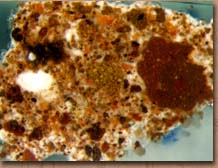
It was deemed necessary to further examine certain aspects through physico-chemical tests. The choice of samples and of types of tests was made mainly in the light of existing deterioration phenomena, but it has also provided results that help to reconstruct the historical phases The table below summarizes data, from tests carried out by the chemist Lidia Barcellona, relating to several samples of mortar. The following elements have been taken into consideration: 1) the original intonaco of the vaults (sample no. 3); 2) the layer of intonaco applied in an unknown period between the vault and the small arches (sample no. 4); 3) the intonaco of the 1914 restoration work (sample no. 5); 4) the intonaco of the south wall discovered during excavation survey number 6 below the present pavement (sample no. 7).
Summary of results from microscopic tests relating to samples : 3,4,5,7
|
Sample No. |
Sample location |
Stratigraphy |
Grain size (size range in mm) |
Degree of selection of proportions: classification |
Fattening (estimated proportion of blinder) |
DSimple definition of pozzolana type |
|
3 |
Impost of the vault, south side ( in the center above CB31) |
1) Lime mortar and pozzolana 2) Lime mixture 3) Pale yellow coloring |
0.02 – 3.2
|
Moderate to scarce |
50% |
Brown pozzolana containing considerable vulcanitie, pyroxene crystals, brown mica and leucite. |
|
4
|
Impost of the vault, south side (on the right of CB31) |
1) Lime mortar and pozzolana 2) Lime mixture 3) Pale yellow coloring
|
0.02-2.6
|
Moderate to scarce
|
50% |
Reddish- brown pozzolana with sparse crystals and fragments vulcanitie. |
|
5 |
Impost of the vault, south side (on the left of CB31) |
1) Lime mortar and red pozzolana 2) Lime and fine-grained red pozzolana based plaster 3) Pale yellow coloring
|
1) 0.03-2.8 2) 0.02 -0.8 |
1) Moderate to scarce 2) Good
|
50% |
Red pozzolana |
|
7
|
Under
the present pavement, south side U S 42 (internal part of cloister)
|
1) Lime mortar and pozzolana |
0.03 – 3.1 |
Moderate to scarce |
50% |
Brown pozzolana with sparse leucite and pyroxene. |
The tests have provided the technical data necessary to satisfactorily plan any kind of treatment to the mortars and have also assisted in their historical classification. For example, the analogy between samples 3 and 7 leads us to believe that they were both part of the same restructuring phase of the cloister and as a further consequence it follows that the pavement is of a later date. The identification of tests to assist in recognizing the components and deterioration processes of the film applied to the coupled orders and pilasters are proving much more arduous.
|
|
|
|
|
Fig.
1 -
Photo of sample no. 3 in reflected light enlarged
approximately 35 times. Detail illustrating the structure of the
intonaco made up of a lime-based binder with a lumpy texture, incorporating
brown pozzolana rich in associated minerals:
pyroxene and mica. |
Fig.
2 - Photo of sample no. 7 in reflected light
enlarged approximately 35 times. Detail of the section illustrating
the structure of the mortar.
|
© 1999 Coordination
Monica Morbidelli
© 1999 Altair 4 Multimedia
© 1999 All the material on this site is under the copyright of
the Monastery of Ss. Quattro Coronati
Webmaster: techaltair@altair4.it